
The Quilts in the Cedar Chest
I thought going through Eldon's house after the funeral would give me answers.
I was wrong.
He'd never been an easy man to know. My grandfather's brother — that's all I'd ever really understood about Eldon. He was the other one. The one who didn't take over the ranch. The one who moved to town, worked at the co-op for thirty years, never married, never said much when he did show up for holidays. He ate, he nodded, he left early. For sixty years of family gatherings, that was Eldon.
When he died he left everything to my mother, who couldn't make the drive, so she sent me.
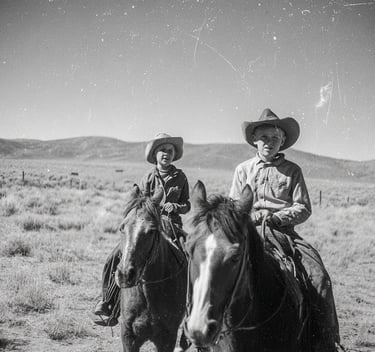
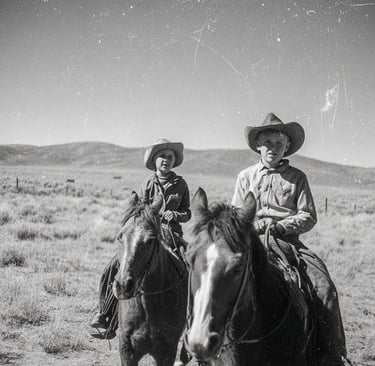
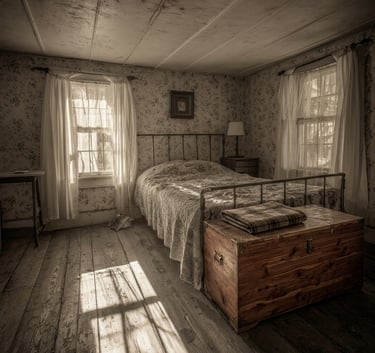
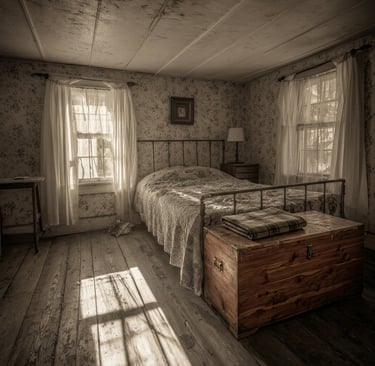
The house was small. A man can live in a remarkably small space, it turns out, and keep it clean. Two rooms that mattered: a kitchen and a bedroom with a window that looked out over a creek bottom where the cottonwoods had gone gold. Everything in its place. No clutter. No pictures on the walls except one — a black-and-white photograph of two boys on horseback, maybe ten and twelve years old, squinting into what must have been a hard afternoon sun. One of them was my grandfather. I recognized the horse.
I worked through the kitchen first. Cast iron, a few plates, coffee cups with no saucers. A drawer full of rubber bands and twist ties organized by size. In the bedroom, work clothes hung in the closet in a row, sorted by season. Boots on the floor. A Bible on the nightstand with the spine cracked open to Psalms.
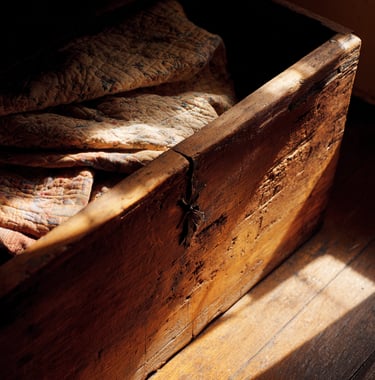
And then, at the foot of the bed — a cedar chest I almost didn't open.
Inside were quilts.
Not one. Not two. Seven of them, folded with a care that seemed almost ceremonial, each one wrapped in a cotton pillowcase to keep the dust off. I lifted the first one out and held it up in the light from the window.
I don't know much about quilts. But I knew this one was old. The colors had gone to the kind of soft that only time makes — faded reds and blues and cream, all pieced together in a pattern I couldn't name. There were small stitches across every inch of it, even, tight, hundreds of hours of work that nobody in that room would ever see unless they held it up to the light like I was doing.
I looked for a tag. A maker's name. Anything.
On the underside of the border, in faded ink on a strip of muslin, was a name. Not Eldon's. A woman's name. And beneath it, a year: 1943.
I sat down on the edge of the bed.
What I didn't understand was that a man's silence can be its own kind of keeping. I had spent forty years reading Eldon's quiet as absence — as having nothing to say, nothing to offer, nothing underneath. But silence can also be how a person holds something too heavy to put down and too private to hand to someone who might not understand its weight.
The things we carry say more about us than the things we talk about.
A man who keeps seven handmade quilts in a cedar chest his whole adult life is not a man with nothing inside him. He is a man who understood value — real value, not the kind you can price. The kind that lives in the hands that made it, in the hours given freely, in the warmth that outlasts the maker by decades. What Eldon kept, he kept with intention. There is a kind of love that looks exactly like practicality.
There were letters in the chest too, bundled with a length of baling twine and tucked along the side. I didn't read them. That felt like a line I had no right to cross. But the envelopes told me enough — the return address, the handwriting, the fact that he had kept them sixty years bound up tight next to those quilts.
He had loved someone. Or someone had loved him. And whatever that was, it had been important enough to carry forward through a co-op job and a small house and forty years of family holidays where nobody thought to ask the right question.
The quilts weren't decoration. They weren't heirlooms in the collecting sense. They were evidence. They were the physical record of something that had mattered, preserved against the indifference of time by one man who understood, maybe better than any of us, what it means to hold onto what's real.
Legacy isn't always announced. Most of the time, it's folded up and put away somewhere quiet, waiting for someone to look.
The things people leave behind have a way of telling the truth their living never did. Not because the living was dishonest — but because life moves fast, and most of what matters gets packed down into habits and silence and small daily acts of preservation that nobody thinks to explain. You just do it. You fold the quilt right. You keep the letters. You hang on.
Think about what gets handed down in your family that nobody named. Not the land or the money, if there was any. Think about what someone preserved without calling it preservation — a skill practiced so long it looked like instinct, an object kept so carefully it outlasted every explanation for why. Think about the cedar chest equivalent in your own life, the thing you've been holding onto without knowing you were doing it for someone else.
There's an old rancher's habit — when you're gathering cattle on rough country, you tie your slicker behind the saddle even on a clear morning. Not because you expect rain. Because you've been caught without one before, and you learned that weather doesn't wait for you to be ready. You carry it because someone taught you to carry it, and they learned the same way, and somewhere back in the line there was a person who got soaked to the bone on a good-looking day and decided their people would never have to learn that lesson the hard way again.
That's the thing about what gets handed down. Most of it was never meant to be an heirloom. It was just the right way to do things, repeated long enough to become permanent.
I took one of the quilts with me when I left. My mother said to, and I didn't argue. It's on the foot of my bed now, which is where quilts belong.
Some mornings I look at it and think about those stitches — how many hours, how many nights, how much of a person's life went into something they never knew would end up here. I don't know if it comforts me exactly. But it does something. It makes the room feel less like a room and more like a place where things that happened are still happening, quietly, under the surface.
Eldon was a man I never knew.
Turns out, he left enough behind that I can start to.
Realwesternlife
Authenticity guaranteed
© 2025. All rights reserved.
Get in Touch:
Orders & Customer Service
orders@realwesternlife.com
General Inquiries
hello@realwesternlife.com
Business, Legal & Privacy
admin@realwesternlife.com
Call or Text
307-240-9474
Our store is